
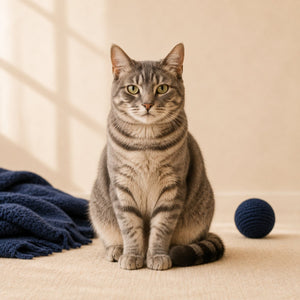

Indoor cats sleep a lot, which makes it easy to forget they were built to hunt. When that energy has nowhere to go, it tends to come out at 4am, usually on your feet.
The good news: a tired cat doesn't take hours. It takes the right kind of play, done a couple of times a day.
Play like prey
A hunt follows a pattern: watch, stalk, chase, pounce, catch, eat. The most satisfying play follows it too. A toy that simply dangles in front of a cat's face isn't prey. A toy that runs away, hides, pauses and twitches is.
- Move the toy away from your cat, never straight at them.
- Let it disappear behind a chair or under a blanket, then peek out.
- Mix fast dashes with still moments. The pause is often what triggers the pounce.
- Let them catch it, often. A hunt with no wins is just frustrating.
Short and often wins
Two or three sessions of 10 to 15 minutes a day suits most cats better than one long one. Dawn and dusk are natural hunting times, so an evening session before your own bedtime can make for quieter nights.
Watch for the signs they're done: lying down with the toy, slower chases, a flicking tail. Stop there.
Finish with a "meal"
End each session by letting them make a final catch, then offer a treat or their meal. It completes the hunt, and many cats groom and settle afterwards. That's the point where a cozy, covered bed earns its place.
About laser pointers
Lasers get cats moving, but they can never be caught. If you use one, finish by landing the dot on a real toy they can grab, or switch to a wand toy for the last minute.
Solo play for when you're busy
Rolling balls, puzzle feeders and toys that move on their own keep a cat busy while you work. They're a great extra, but they don't replace playing together. Your cat wants a hunting partner, not just equipment.
Keep toys safe and interesting
- Put wand toys, string and ribbon away after play. Swallowed string can cause a serious gut blockage.
- Rotate toys every few days so old favorites feel new again.
- Check toys for loose parts and replace anything falling apart.
When it might not be boredom
Night-time zoomies and ankle ambushes are usually spare energy. But over-grooming, bald patches, hiding, changes in appetite or litter box habits, or a sudden drop in interest in play are worth a vet check. Senior cats still like to play, just gently and closer to the ground.